Building change during testing into the model
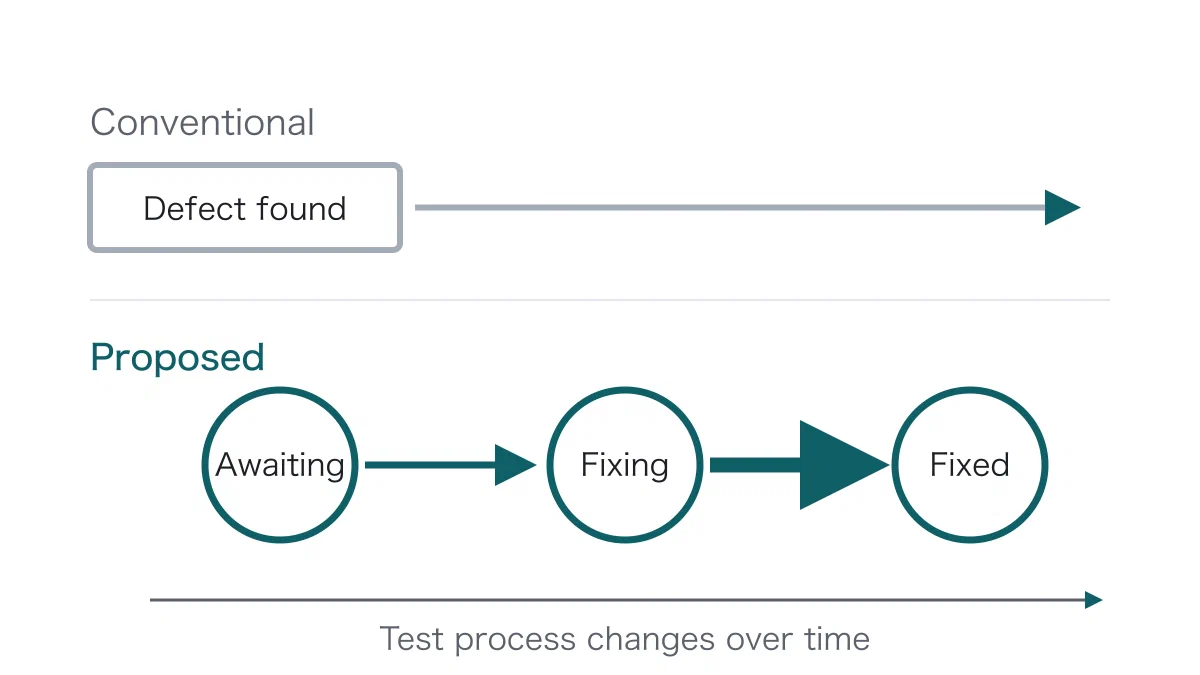
Most software reliability growth models describe defect discovery as a non-homogeneous Poisson process. That is convenient, but it cannot express what actually happens on a project: a defect that is found is not necessarily fixed at once, and the testing regime itself changes partway through.
This work models the process as a non-homogeneous Markov process instead. The system moves between several states — awaiting detection, under repair, and so on — and the transition rates are allowed to vary with time, which captures mid-project change naturally.
More states mean more expressive power but heavier computation. The contribution here is a computational method that remains practical, together with an evaluation on real data.
The result sits where our long-running work on the numerical analysis of Markov chains meets software reliability assessment.
Source paper
Nonhomogeneous Markov Process Modeling for Software Reliability Assessment
IEEE Transactions on Reliability (2023)